


The long lens is your friend
There's a quiet satisfaction in nailing a landscape shot from a distance. A 70–200mm or a 100–400mm lens lets you compress a ridge line, isolate a lone hawthorn against a storm sky, or frame a lighthouse from a path rather than a patch of fragile ground. The result often looks more considered than a wide-angle shot taken from the middle of a bog.
Zooming in isn't a compromise. It's a technique. On the limestone pavement above Malham, the clints and grykes take centuries to form and can be damaged by a single boot. On the peat hags of Kinder Scout or the flow country of Caithness, a misplaced step can leave a scar that lasts decades. Standing on a solid path and using magnification gives you the same composition without the footprint.
If you can't get the frame you want, crop in post. Modern sensors give you plenty of room, and a slightly softer image is a fair trade for leaving the ground intact.
Stay on the path, even when it's a bog
Paths exist to concentrate footfall. That's their whole purpose. It can feel illogical to squelch through a muddy ribbon when the grass beside it looks dry and inviting, but that grass is often the very thing the path is protecting. Cut a corner on a zigzag and you start a new erosion channel that will widen with every walker who follows.
A few practical habits help:
- Use stone flags and boardwalks even when they're wet and slippery — they're there because the ground underneath can't take traffic.
- Fit rubber feet to tripod spikes on soft ground, or rest the tripod on rock and brace it with your body.
- Never trample vegetation to get a better angle. The angle is rarely worth it, and the damage is visible for years.
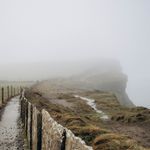
- On coastal paths, stay well back from cliff edges. They crumble, and the best view of a headland is often from the path behind it.
If the path is genuinely impassable, turn around. There's no photograph worth a broken ankle or a new scar on the hillside.
Give nesting birds and coastal wildlife a wide berth
The UK breeding season runs roughly from March to July, though some species start earlier and some finish later. Ground-nesting birds are the ones to watch for: ringed plover and oystercatcher on shingle beaches, skylark and meadow pipit on moorland, Arctic tern and puffin on cliff tops.
These birds don't just get startled. They abandon nests, and eggs or chicks are lost to cold or predators within minutes. A single footstep can crush a clutch you never saw.
What that means in practice:
- Keep to established paths on cliff tops and dunes, even where a shortcut looks obvious.
- Use the long lens rather than creeping closer. If the bird is reacting to you, you're too close.
- Check local seasonal restrictions before you go. Some reserves and estates ask walkers to avoid certain routes in spring, and the signs are there for a reason.
- Keep dogs on a short lead near nesting areas and livestock.
- Leave the drone at home around cliffs and colonies. The disturbance is real and often illegal.
Carry everything out — and then some
Most hill walkers know the mantra, but photographers carry more small kit than most: spare batteries, lens caps, cable ties, cleaning cloths, foam inserts. These are exactly the things that blow away or drop unnoticed.
Do a kit check before you leave a summit or a viewpoint. A lost lens cap is litter. A dropped bit of foam is microplastic. Fruit peel and apple cores are not "natural" on a mountain — they're food waste that attracts scavengers and looks grim.
A small stuff sack for litter costs nothing and weighs nothing. If you find a wrapper or a bottle on the path, pick it up. Most of us have room.
Share locations responsibly
Social media has changed how UK landscapes are used. A single geotagged shot of a quiet corrie or a secret beach can send hundreds of people to a place that has no parking, no toilets and no capacity for them.
That doesn't mean keeping every view to yourself. It means thinking about what you post and how.
- Consider removing the exact location from your post, or sharing a general area rather than a precise grid reference.
- Avoid tagging fragile or sensitive spots during nesting season.
- If you do share a location, add context: where to park, which path to take, what seasonal restrictions apply.
- Share the approach as well as the shot. The walk is part of the story.
The best landscape photography leaves the place exactly as it was — or better, because you carried out someone else's litter on the way. A good image lasts for years; a boot print in a peat bog lasts a lot longer.


John Doe
14 January, 2022Having no content in post should have adverse..
Chauffina Carr
10 April, 2022We use these tests all time! Killer stuff!
Jim Séchen
16 July, 2022Thanks for all the comments, everyone!